
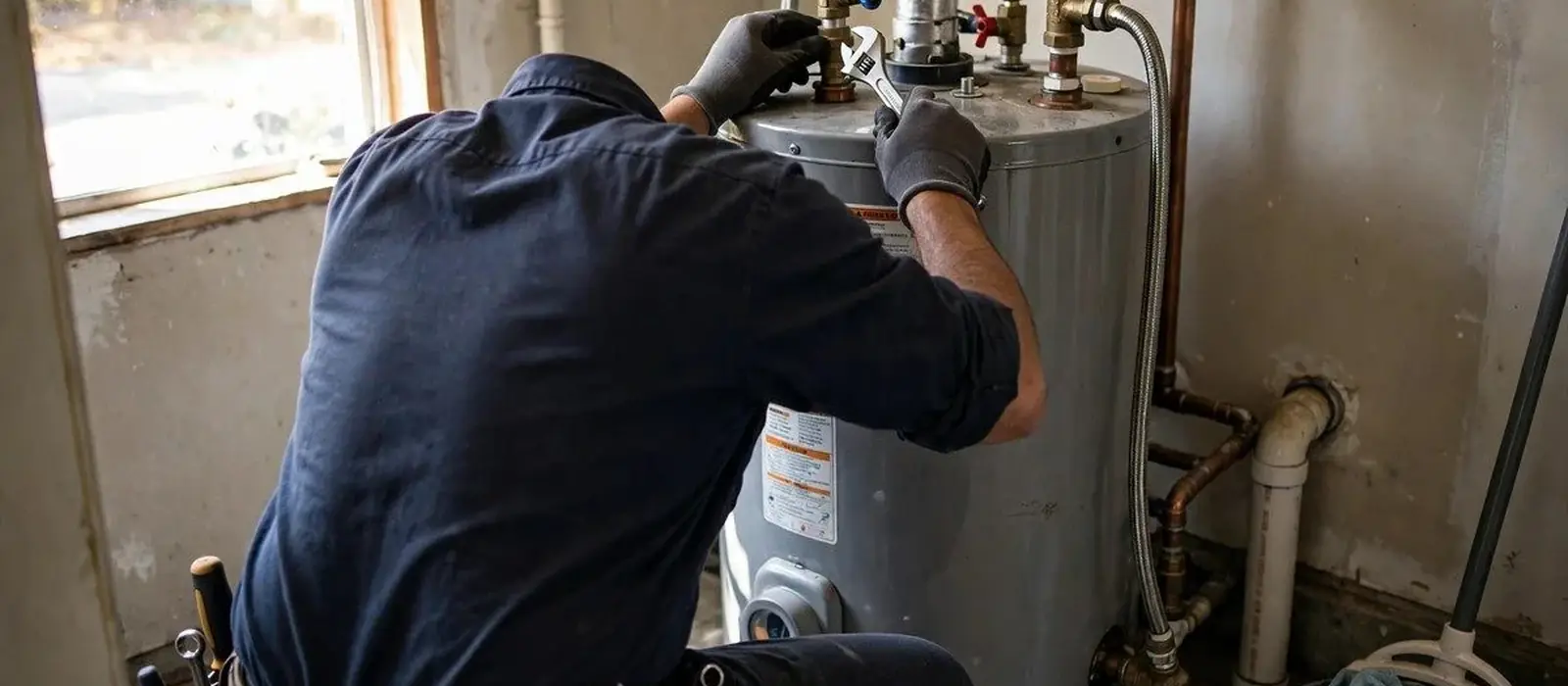
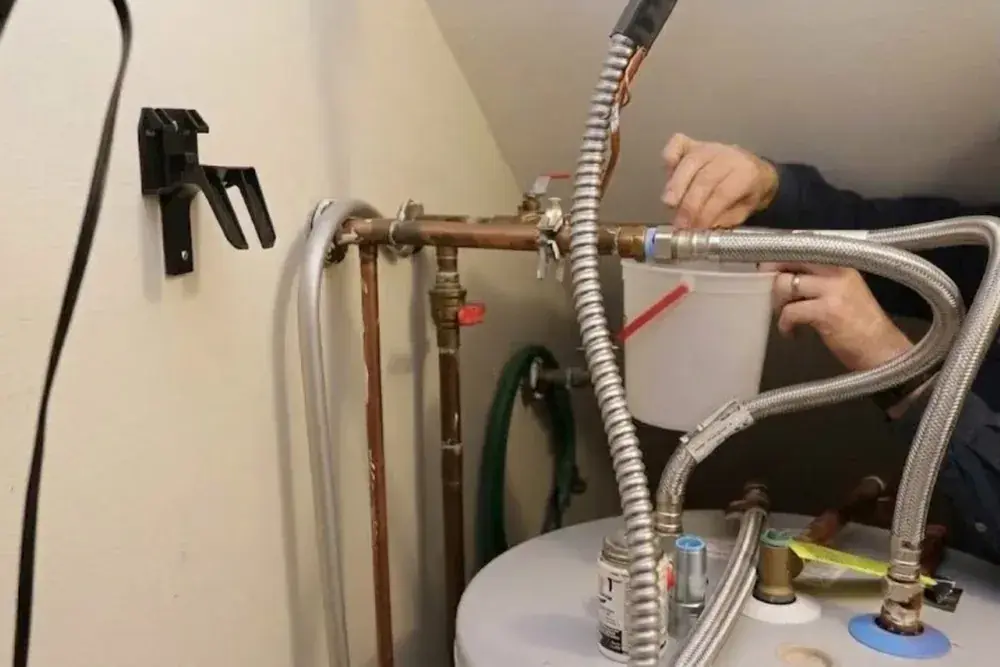
When a water heater problem is an emergency
A leaking tank, a burst supply connection or water near the heater's electrical or gas controls is an emergency. No hot water is urgent in a different way, because it affects daily life but usually does not damage anything.
If water is leaking, switch off the heater at the breaker or set a gas heater's control to off, close the cold-water shutoff valve on top of the tank and keep people away from the wet floor. If you smell gas, leave the home and call the gas utility or 911 first. Our 24/7 line is (714) 750-8637.
What fails on a water heater
Tank water heaters have a few parts that wear out. On gas units that includes the thermocouple, the gas control valve and the pilot assembly. On electric units it is the upper and lower heating elements and the thermostats. On both, the anode rod, the temperature and pressure relief valve and the drain valve age with time.
A plumber starts by identifying which of those parts matches the symptom. Water that is lukewarm and runs out fast often points to a failed lower element or a heavily scaled tank. Water that is hot for a minute and then cold often points to a broken dip tube.
Symptoms and what they usually mean
Match your symptom to the likely cause. A plumber confirms with tests before replacing anything.
No hot water at all
On electric units, a tripped breaker or failed upper element. On gas units, a pilot that will not stay lit or a bad thermocouple.
Water not hot enough
A failed lower element, a thermostat setting that drifted or sediment insulating the tank bottom.
Rumbling or popping
Mineral sediment cooking at the bottom of the tank. Common with hard water and often a sign the tank is aging.
Water around the base
A loose fitting or relief valve may be repairable. A leak from the tank body is not, and replacement is the answer.
Why scale matters in Fountain Valley
The city's 2026 water quality report lists average hardness of 217 milligrams per liter, which is 13 grains per gallon, with a range of 10 to 15. The city's own FAQ describes water with 10 grains or more as hard. Hard water leaves mineral scale on heating elements and the tank floor, and that scale is why elements burn out and tanks rumble.
Flushing a tank every year can slow the buildup, but sediment that has been left for years may not come out and flushing a very old tank can start a leak. Ask the plumber whether a flush is worthwhile for your unit. Persistent scale problems are also a reason to price a water softener.
Repair or replace?
Age and the type of failure decide most of these decisions. This table shows how plumbers usually weigh it.
| Situation | Usually repair | Usually replace |
|---|---|---|
| Tank age | Under about 8 years | Over about 10 to 12 years |
| Failed part | Element, thermostat, thermocouple, valve | Leak from the tank body |
| Condition | No rust, normal sediment | Rusty water, heavy sediment, repeat repairs |
| Cost logic | Repair is a fraction of a new unit | Repair cost approaches the price of a replacement |
No hot water tonight?
Call the 24/7 line and a plumber can plan the repair or replacement.
Gas, electric and tankless units
Gas heaters need venting checks and combustion safety. If a gas heater has soot, scorch marks or a flame that is yellow instead of blue, the plumber will treat it as a safety issue before a comfort issue. Electric heaters need power testing with the circuit off, and elements are usually swapped as a pair.
Tankless units fail differently. Error codes, cold-water sandwiches and weak flow are often scale in the heat exchanger. Descaling is a common service, covered on our tankless water heater page.
What water heater repair costs
We do not post fixed prices because a thermostat and a gas valve are different parts and a leak from the tank is a different outcome. You hear the price before work starts.
What moves the final number
Home warranty coverage may apply to a repair, and your manufacturer's warranty may cover a failed tank in its first years. Check the model label and call (714) 750-8637 with the details.
No hot water: a quick check before you call
Check the breaker for an electric heater and the pilot light for a gas heater. Make sure the thermostat is not set to vacation mode. If the reset button on an electric unit has tripped, press it once, and if it trips again do not keep resetting it, because that points to a failed element or wiring fault.
If you reach the end of that list and still have no hot water, call. We note what you have already tried so the plumber can skip those steps.
Safety rules that apply to heaters
California law requires water heaters to be braced or strapped against earthquake movement, and the California Plumbing Code, based on the UPC, calls for a temperature and pressure relief valve with a proper discharge pipe. A repair visit is a good time to check both, since a loose strap or a capped relief line is easy to miss.
Check the relief valve line
A water heater has a temperature and pressure relief valve that opens when the tank gets too hot or too pressurized. A trickle or drip from the discharge pipe can mean the valve is failing, or it can mean thermal expansion that needs an expansion tank. Either way the valve should not be capped or plugged.
If the discharge pipe is running and the water is very hot, turn off the heater and call right away.
Common Questions
Yes. Our emergency line is open 24/7 for leaking tanks and no-hot-water calls. Call (714) 750-8637 and describe what you see. Same-day appointments are offered when available.
Tank water heaters often last roughly 8 to 12 years, though hard water, missing maintenance and installation quality all change that. Your unit's label shows the manufacture date in the serial number.
Rumbling or popping is usually sediment at the bottom of the tank. In Fountain Valley, where the city reports average hardness of 13 grains per gallon, sediment is a common cause.
If the leak is from a fitting, valve or drain, often yes. If it is from the tank body, no. The tank is a sealed vessel and the answer is a new water heater installation.
It can be, because it can mean a failing thermocouple or a venting problem. Treat any gas smell as an emergency and leave the home. Otherwise, call for a diagnosis.
Permit rules vary, so ask the City of Fountain Valley Building Division at 714-593-4429. The plumber can tell you what applies to your repair.