
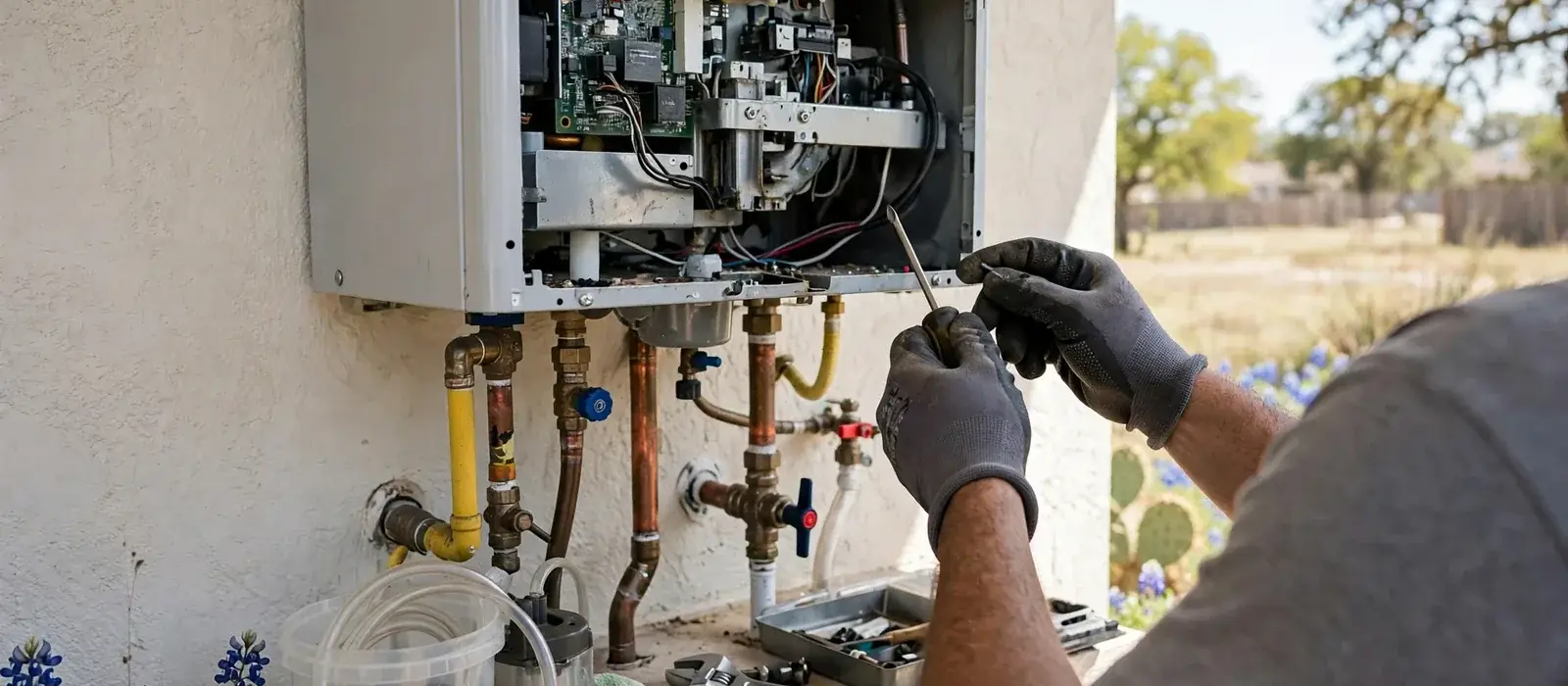
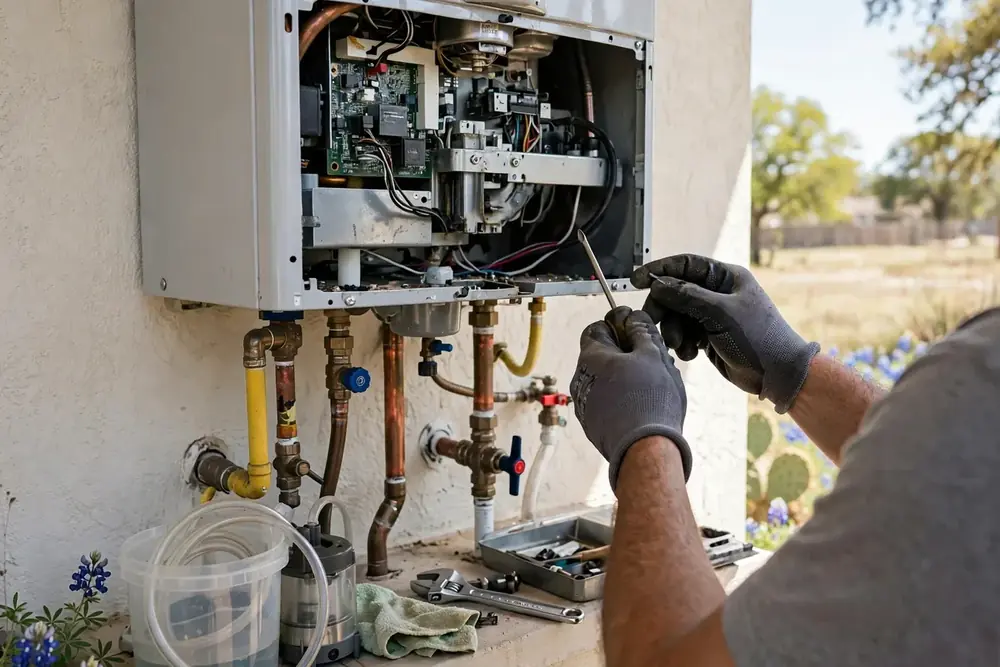
How a tankless heater decides to heat
When you open a hot tap, a flow sensor tells the unit that water is moving. If the flow is above the minimum, the control board opens the gas valve or powers the elements, and ignition starts. A temperature sensor on the outlet then adjusts the output to match the setpoint.
A fault anywhere in that chain, from a weak flow to a dirty sensor, can stop the heat. The error code on the display is your best clue, so write it down before you reset the unit.
Quick checks before you call
Check power and gas
Make sure the unit is plugged in or the breaker is on, and that the gas valve is open. A recent gas appliance change or a closed valve is a common cause.
Look at the display
Note the error code and look it up in the unit's manual. Codes point to ignition, flow, venting or temperature faults.
Test the flow
Open one hot tap fully. If the unit fires, the problem may be low flow at a single fixture, such as a clogged aerator.
Check the inlet filter
A small screen on the cold inlet can clog with debris. Turn off the water and gas, then rinse the screen.
Scale is the most common culprit in hard water
A tankless heat exchanger has narrow passages. Hard water leaves mineral scale in those passages, which restricts flow and traps heat. The unit may overheat, throw a code or deliver less hot water than the setpoint.
A descaling flush circulates a mild acid solution through the heat exchanger and dissolves the buildup. Units with isolation valves make this a short job. Without them, a plumber can add valves at the same visit.
What the city's report says about your supply
The City of Fountain Valley's 2026 water quality report lists average hardness of 217 milligrams per liter, or 13 grains per gallon, with a range of 10 to 15 grains. The report covers 2025 data and says the city supplied groundwater only that year.
A tankless unit heats water passing through it in seconds, so every gallon that crosses the heat exchanger deposits some minerals. In hard water areas, manufacturers often recommend descaling on a yearly schedule. Check your unit's manual for the interval and flush procedure.
Source type: City of Fountain Valley 2026 Water Quality Report
Symptoms and what they tell you
The pattern of the failure narrows the cause.
Cold water sandwich
A brief cold burst between hot water uses. Often normal with short draws, or caused by low flow.
Hot at first, then cold
Scale or an overheating safety device cutting the burner.
Never lights
Gas supply, igniter or flame sensor fault. Do not attempt gas repairs.
Error code after a few seconds
Venting blockage, condensate drain issue or a flow fault.
If you smell gas
Leave the building, do not touch switches or phones inside, and call the gas utility or 911 from a safe place. Do not try to relight a unit that smells of gas. After the area is cleared, call a plumber.
Flow, pressure and recirculation
Tankless units need a minimum flow to fire, often a fraction of a gallon per minute. Low-flow fixtures, a partly closed valve or a clogged aerator can drop below that threshold. Ask whether the heater is firing when you open a different tap.
If your home has a recirculation pump or a crossover between hot and cold lines, a tankless unit can behave oddly. A faulty check valve can let cold water into the hot line. A plumber can test this with a few temperature readings.
DIY or call a plumber?
Some steps are safe for owners. Others involve gas, venting or live electrical parts.
| Task | Owner can try | Call a plumber |
|---|---|---|
| Clean aerators and inlet screen | Yes | If flow is still weak |
| Reset the unit | Once, after noting the code | If the code returns |
| Descale the heat exchanger | With the right valves and instructions | If you have no isolation valves |
| Ignition, venting, gas valve | No | Always |
What to do if the unit smells of gas
Leave the building, do not touch switches inside and call the gas utility or 911 from outside. Tankless installs follow the California Plumbing Code, based on the Uniform Plumbing Code (UPC), and the manufacturer's venting rules, so a vent problem is a safety issue and not a comfort issue.
Getting service in Fountain Valley and Santa Ana
If the checks do not solve it, a plumber can read the diagnostic history, test the sensors and check the heat exchanger. Our tankless water heater page describes the service, and the water heater repair page covers tank units.
We answer the 24/7 line for homes in Fountain Valley and in Santa Ana. The service areas page explains how coverage works for nearby cities.
Questions Fountain Valley Homeowners Ask
Common causes are low flow, scale, a gas or power issue and sensor faults. The error code on the display is the best place to start.
Many manufacturers suggest once a year in hard water. The City of Fountain Valley reports 13 grains per gallon on average, so this city falls in that range.
Not usually, but if you smell gas treat it as an emergency and leave the building. Otherwise turn the unit off and call for service.
Some owners do, with isolation valves and a pump. Follow the manual closely and avoid mixing chemicals.
That is normal in hard water without a softener or regular flushes. A softener plan can help, see the water softener page on this site.