
Start by asking where the pressure is low
The first question is whether one fixture is weak or the whole house. A single weak faucet points to that fixture. A weak hot tap with normal cold points to the water heater or hot lines. All taps weak points to something shared, such as the main valve, the regulator or the service line.
Test a few taps, hot and cold, and a hose bib outside. Write down what you find. The pattern is the most useful clue you have.
Pattern and likely cause
Use the pattern to choose a first step.
| What you notice | Likely cause | First step |
|---|---|---|
| One faucet weak | Clogged aerator or cartridge | Clean the aerator, see faucet repair |
| Hot water weak, cold normal | Heater valve, scale or hot line | Check the heater's outlet and shutoff |
| Whole house weak | Main valve, regulator or service line | Check the main valve, then call a plumber |
| Sudden drop plus wet yard | Break in the service line | Close the main, see water line repair |
Checks you can do yourself
Open the main valve fully
Gate valves can be partly closed after plumbing work. Open yours all the way.
Clean the aerators
Unscrew the aerator, rinse the screen and soak it in vinegar to dissolve scale.
Use a pressure gauge
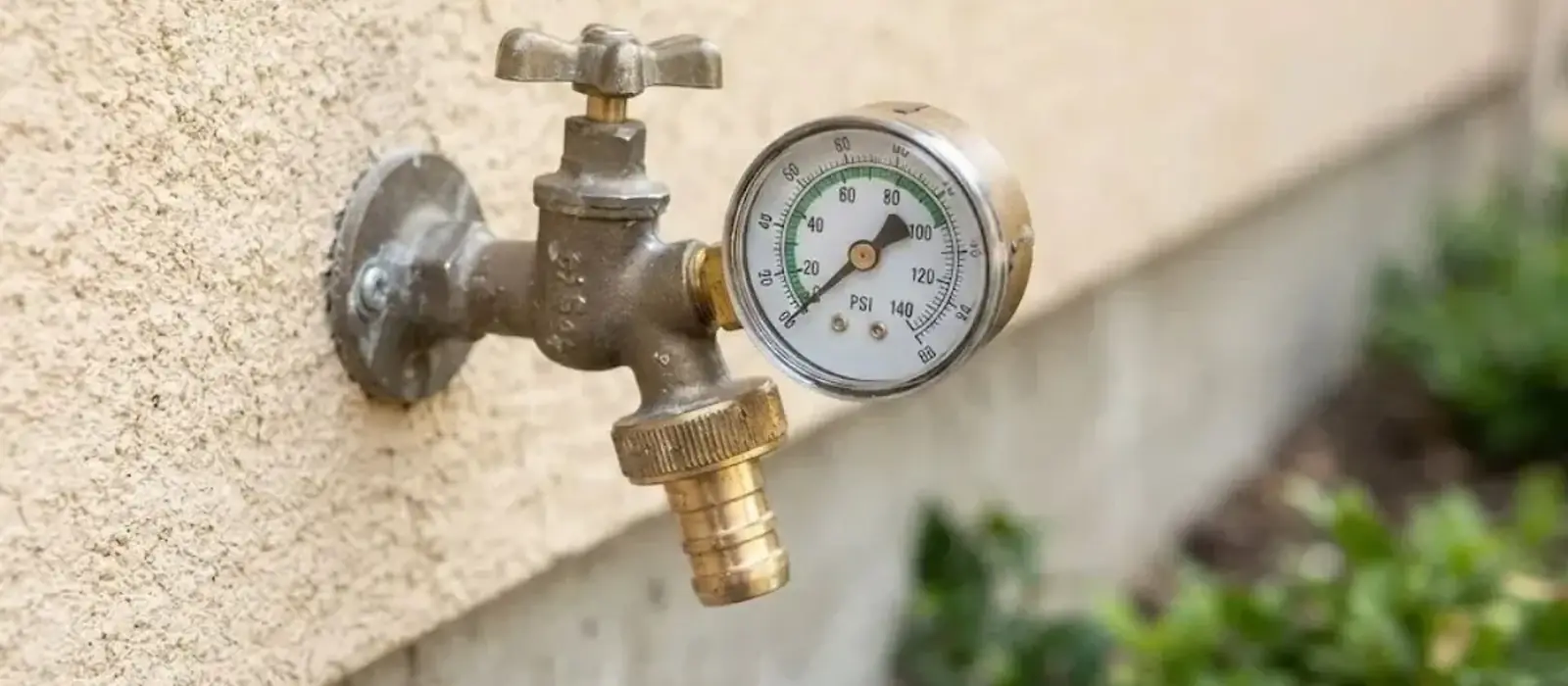
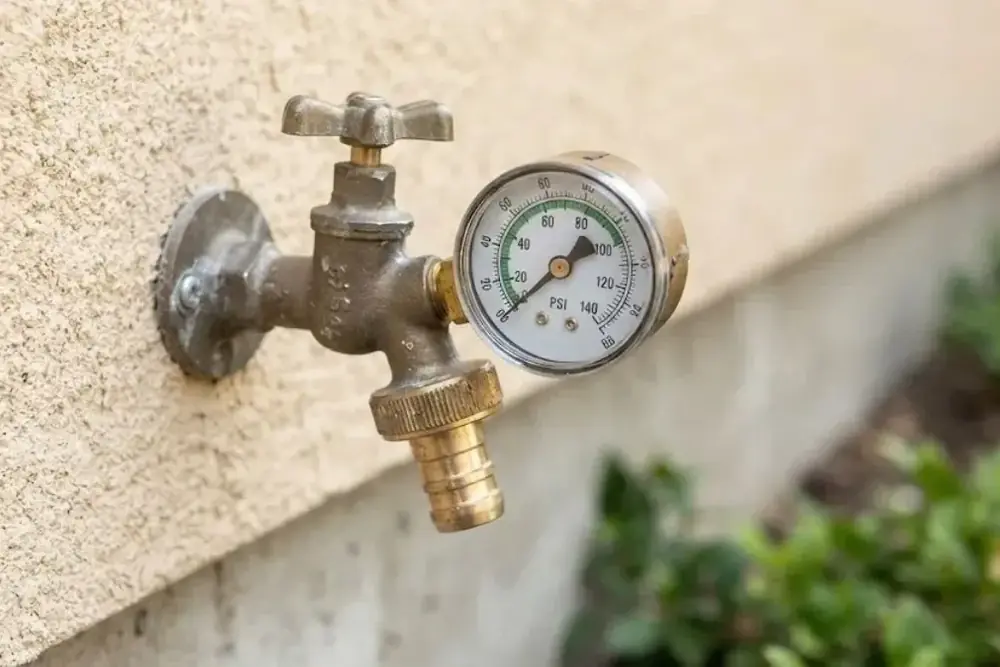
A gauge on a hose bib reads static pressure. Many homes sit in the range of 40 to 80 psi.
Check the regulator
If the gauge reads low or very high, the pressure regulator near the main may be failing.
Scale and the city's water
The City of Fountain Valley's 2026 water quality report lists average hardness of 217 milligrams per liter, or 13 grains per gallon, with a range of 10 to 15. Hard water leaves mineral scale at aerators, in showerheads and inside older pipes.
Scale narrows openings gradually, so pressure may fall over months with no sudden event. The report also states that the city supplied groundwater only in 2025. If you suspect a problem on the city side of the meter, contact the city. If your gauge reads normal at the meter and low in the house, the problem is on your side.
Source type: City of Fountain Valley 2026 Water Quality Report
Galvanized pipe and corrosion
Older homes may have galvanized steel supply pipe. It rusts on the inside, and the rust builds up until the opening shrinks. Pressure can fall slowly, and the water may turn brown. This is not a quick fix. The usual solution is replacing the pipe, which our repiping page describes.
Copper can also narrow with scale, though it takes longer. A plumber can check the pipe material at a visible point and measure flow.
Regulators: too low and too high
A pressure regulator, often a bell-shaped valve near the main, reduces street pressure to a safe level for the house. A failing regulator can let pressure drop, or let it spike. Spikes are hard on fixtures and appliances.
Regulators wear out over many years. A plumber can test it with a gauge and replace it. Do this before you replace piping, since a bad regulator can mimic pipe problems.
Sudden drop with a wet spot
If pressure falls suddenly and you see water in the yard or the meter spins with everything off, close the main and call. A break in the service line is an emergency, and the 24/7 line is the right number.
How to read a pressure gauge
Screw a pressure gauge onto an outdoor hose bib, close every fixture and open the bib fully. The needle shows static pressure. Then run a few indoor fixtures and watch the needle. A big drop under load points to a restriction between the meter and the house.
Write down both readings. They help a plumber decide whether the problem is supply, regulator or piping.
Water heater and softener effects
A partly closed valve at the water heater can restrict hot water alone. So can a clogged heater outlet screen. If you have a softener or filter, a clogged cartridge or a bypass in the wrong position cuts flow to the whole house.
Check that bypass valves are set correctly and that filter cartridges have not exceeded their life.
What the code says about pressure
The Uniform Plumbing Code (UPC), which the California Plumbing Code is built on, calls for a pressure regulator when pressure could exceed 80 psi. That is why a reading in the 40 to 80 range is considered normal, and a reading above 80 points to a regulator that needs replacing.
When to call us in Fountain Valley and Santa Ana
Call a plumber if the whole house is weak, the gauge reads low at the meter or you suspect a hidden leak. Leak detection finds leaks that lower pressure, and buried line problems are repaired as described on the water line repair page.
We serve Fountain Valley and the neighboring city of Santa Ana. The service areas page explains how coverage works.
Questions Fountain Valley Homeowners Ask
Many homes run between 40 and 80 psi. A gauge on a hose bib gives the reading.
Often scale in the showerhead or a restrictor. Soak the head in vinegar and rinse.
Over time, yes. Scale narrows aerators and old pipes. Fountain Valley's city report lists 13 grains per gallon on average.
Sometimes. A leak in the service line can lower pressure. A spinning meter with fixtures off is a stronger sign.
If a gauge shows the pressure is outside the normal range and the regulator is old, replacement is often the fix.