
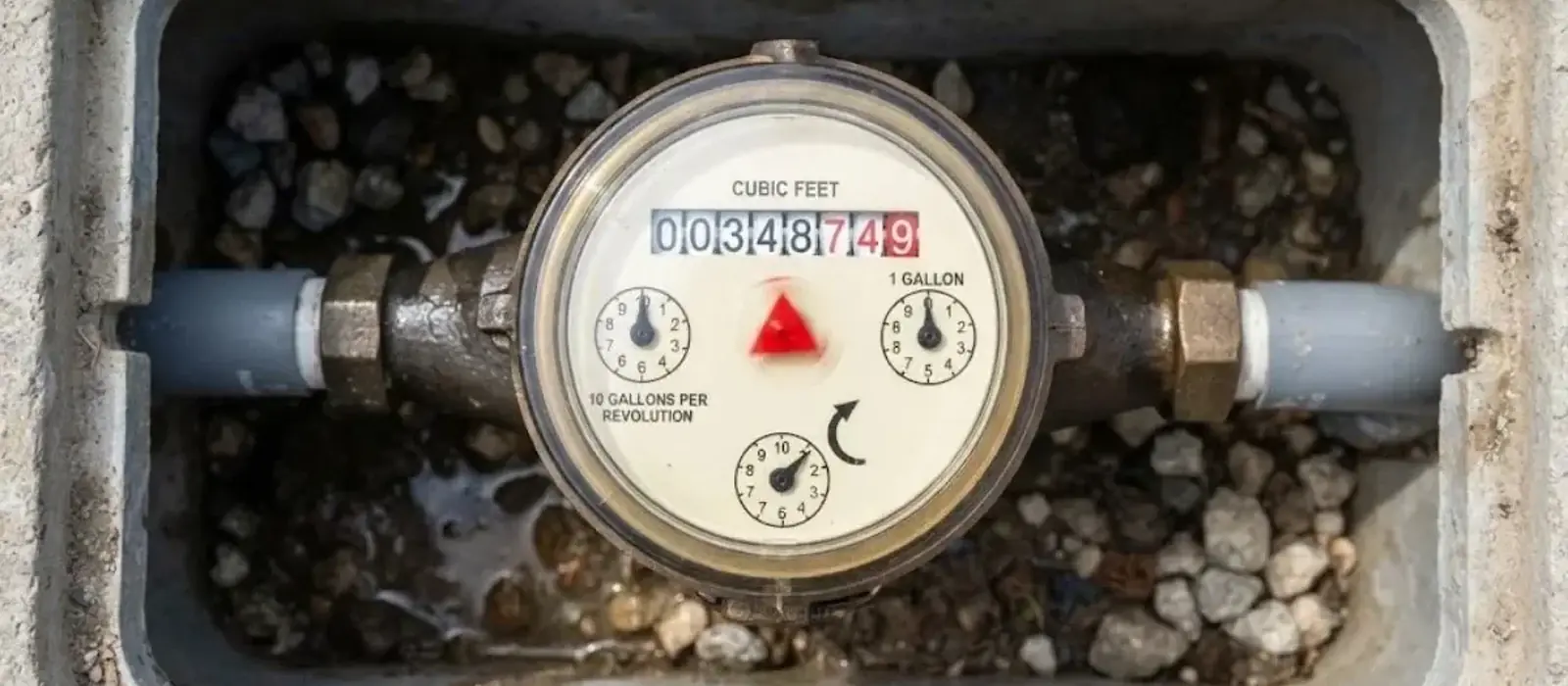
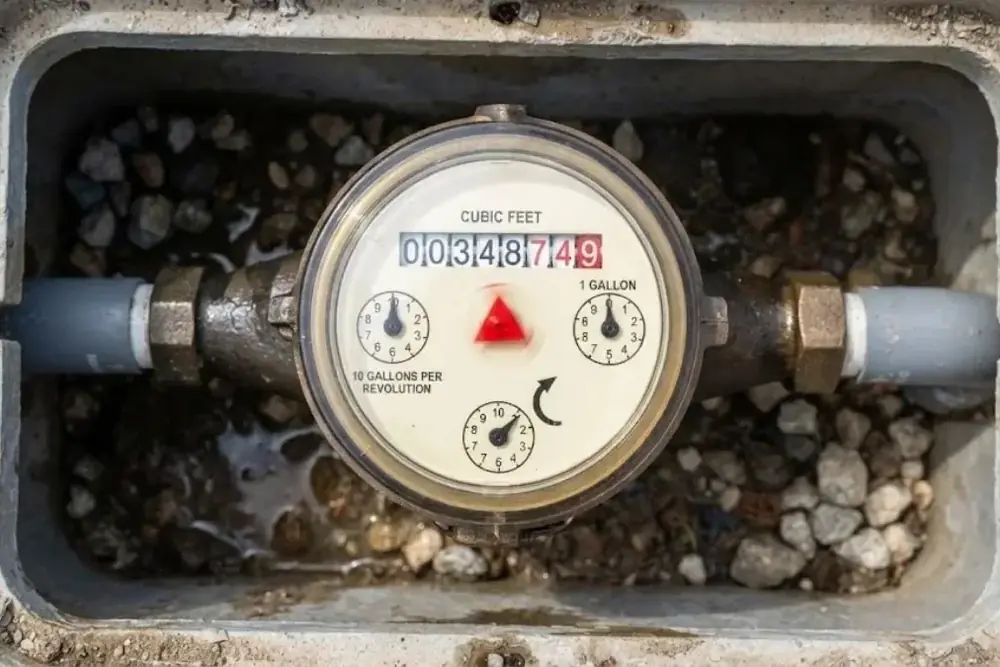
How to read the meter
Most residential meters have a register that shows total usage and a small dial or triangle that spins when water flows. The low-flow indicator is the key. If it moves when nothing is running, something is using water.
Turn off every faucet, the washer, the dishwasher, the ice maker and the irrigation. Check that no one is using a toilet. Then watch the indicator for a minute, and note the register reading to compare after 15 minutes.
Split the problem in two
Close the house main
Find the main shutoff at the house and close it fully.
Watch the meter
If the indicator stops, the leak is on the house side of the shutoff.
If it keeps moving
The leak is in the service line between the meter and the shutoff.
Note and call
Write down which case you have. It is the first thing a plumber asks.
Common reasons the meter moves
Not every case is a broken pipe.
| Cause | Typical sign | Next step |
|---|---|---|
| Running toilet | Faint trickle sound, dye in the bowl | Replace flapper or fill valve |
| Irrigation leak | Wet patches, low pressure in zones | Inspect zones and valves |
| Service line break | Wet yard, meter moves with main closed | Call a plumber, see water line repair |
| Hidden pipe leak | Bill climbs, stains or warm floor | Leak detection |
The city's role and your role
The City of Fountain Valley's 2026 water quality report states that the city supplied groundwater only in 2025, so the water that passes your meter comes from city wells. Questions about your bill, meter accuracy and usage history go to the city, which can tell you how to read your meter and whether it shows the same movement.
In general, the utility handles the meter and the owner handles the pipe past it. Ask the city to confirm where the line of responsibility sits at your address.
Source type: City of Fountain Valley 2026 Water Quality Report
High bills that are not pipe leaks
Not every bill spike is a leak. Filling a pool, a new irrigation schedule, houseguests or a stuck valve can all raise usage. A bill can also cover more days than usual. Compare the dates on your last statements before you assume a leak.
If the meter stays still with everything off, the bill likely reflects real use. If it moves, treat it as a leak until proven otherwise.
If you find the leak is outside
Water bubbling up in the yard, a sunken patch in pavers or a soggy lawn stripe along the line suggests a break in the service line. Close the house main to see whether it stops. If the water continues, the break is on the meter side of your valve.
Do not dig randomly. A plumber can trace the line and find the break, which saves a lot of yard work.
Do not ignore a moving meter
A small leak can run for weeks and cost more than a repair. If the meter keeps moving after your checks, call. If water is visible and flowing, close the main and use the 24/7 line.
Keep a simple leak log
Write down the meter reading at the same time each day for a week. Add notes about showers, laundry and irrigation. A leak shows up as use on days when nobody was home. This record is also useful to a plumber and to the city if you question a bill.
Take a photo of the meter face each time. Some meters have a leak indicator that blinks. Record whether it is on.
What the plumber will ask
Expect questions about where the meter is, whether the indicator moves with the main closed, how old the home is and whether you have irrigation or a pool. Have the answers ready.
Tell the plumber what you have already ruled out, such as toilets and irrigation. It saves time and helps the plumber choose the first test.
Rules that apply after a leak is found
Repairs to a leaking line follow the California Plumbing Code, based on the Uniform Plumbing Code (UPC), and replacing a service line usually needs a permit. According to the City of Fountain Valley's water quality report, the 2025 supply came from groundwater only, so any metering question goes to the city.
Getting help in Fountain Valley and Santa Ana
Our leak detection page explains how plumbers find hidden leaks, and the water line repair page covers the buried line. We serve Fountain Valley and the neighboring city of Santa Ana.
The service areas page explains how coverage works.
Questions Fountain Valley Homeowners Ask
Water is flowing somewhere, such as a toilet, an irrigation line or a leak. The meter test helps find which.
Close the main at the house. If the meter stops, the leak is inside. If it keeps moving, it is in the line to the house.
Generally no. The owner is responsible beyond the meter. Confirm with the city.
Yes. A leaking flapper can pass a thin stream into the bowl.
Rarely the bill itself. Some policies cover resulting damage. Ask your insurer.