
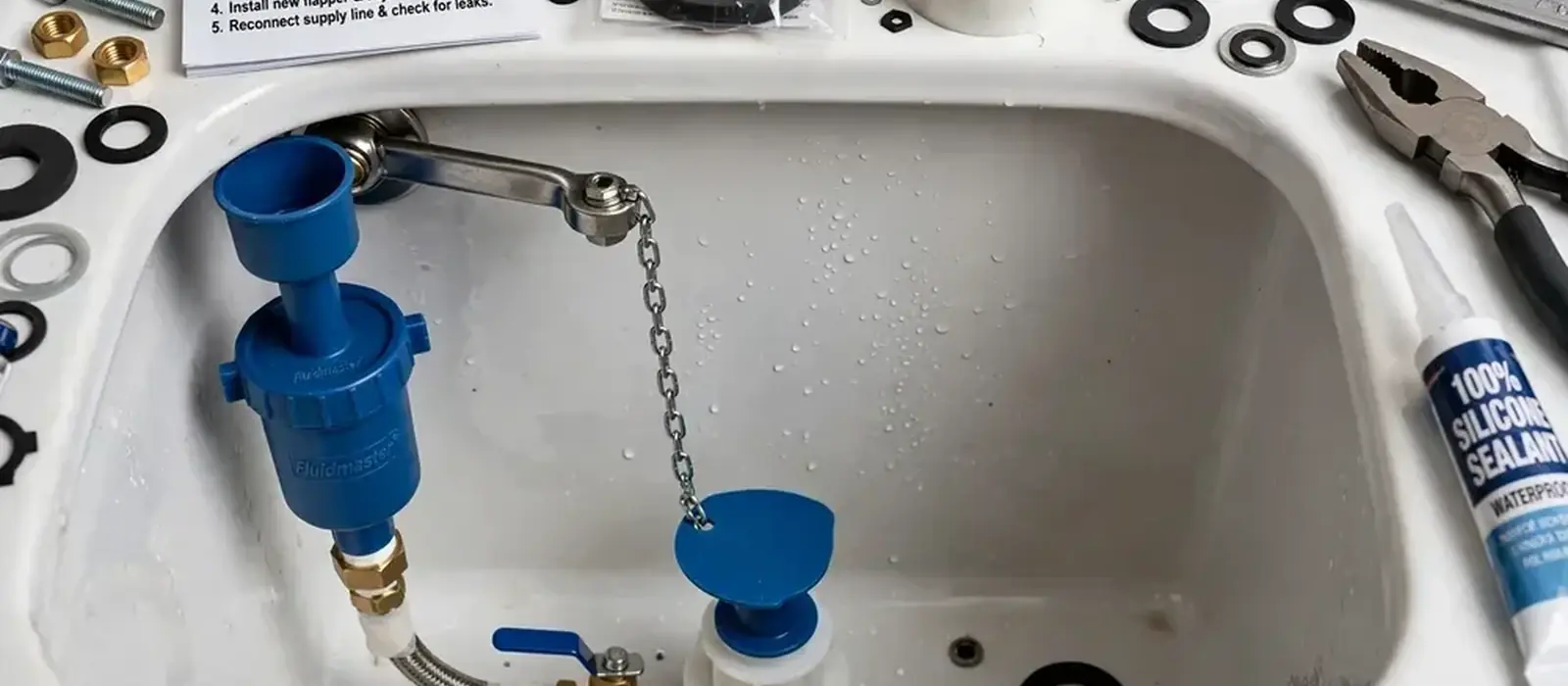
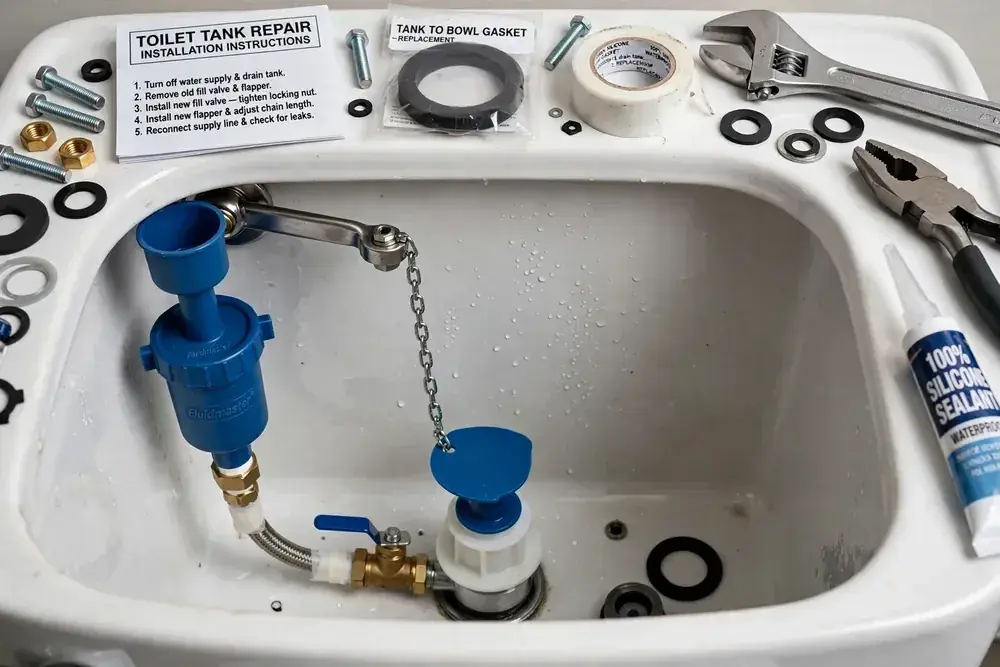
The three connections behind every toilet
A toilet connects to a cold-water supply, a drain and a vent. The supply line brings water to the tank through a small shutoff valve on the wall or floor. The drain carries waste out through the floor flange to the main drain line. The vent, a pipe that runs up through the roof, lets air in behind the water so that the drain flows freely.
If any of the three is wrong, the toilet will not work well. A missing vent causes slow flushing and gurgling. A loose flange causes leaks. A bad supply valve causes constant running or a trickle.
Parts list and what each does
Know the parts before you buy anything.
| Part | Job | Common problem |
|---|---|---|
| Closet flange | Fixes the toilet to the floor and connects to the drain | Cracked or set too low |
| Wax ring or seal | Seals the base to the flange | Leaks after the toilet rocks |
| Closet bolts | Hold the bowl in place | Corroded or loose |
| Supply line and angle stop | Carry water to the tank | Slow drip or stuck valve |
The order of work for a replacement
Shut off and drain
Close the angle stop, flush and sponge the tank and bowl dry.
Disconnect and lift
Remove the supply line and the nuts at the base, then lift the toilet straight up and set it on a towel.
Check the flange
Scrape off the old wax, look for cracks and confirm the flange sits at or slightly above the floor.
Set the new toilet
Place a new wax ring or seal, lower the bowl evenly, tighten the bolts in small turns, reconnect water and test.
Rough-in and why it matters
The rough-in is the distance from the finished wall to the center of the flange. Twelve inches is the most common, but older homes and some remodels use 10 or 14. If you buy a 12 inch toilet for a 10 inch space, it will not fit against the wall.
Measure before you shop. A tape from the wall to the flange bolts is enough. Also check the width of the space and the height of any vanity or window nearby.
Signs the flange needs repair
A toilet that rocks, a floor that feels soft near the base and a toilet that leaks even after a new wax ring all point to a flange problem. Repair rings and extenders can help, but rot in the subfloor is a bigger job. A plumber can assess it.
Permits and the City of Fountain Valley
The City of Fountain Valley Building Division, at 10200 Slater Avenue, handles permits for plumbing work. Its phone number is 714-593-4429, and the Permit Center portal accepts applications electronically. Counter hours are Monday through Thursday, 7 a.m. to 6 p.m., and closed Fridays.
Swapping a toilet in the same spot often does not need a permit. Adding a toilet, moving one or changing drain and vent lines usually does. Ask the Building Division what applies to your project before you start.
Source type: City of Fountain Valley Building Division
Adding a new toilet or bathroom
A new toilet means a new drain line sized for the fixture, a vent and a cold-water supply. The drain must slope toward the main line, and the vent must connect properly. The slab or floor structure determines whether pipes can go underneath or must run through walls.
This is the stage where a professional matters most. Mistakes inside walls or under a slab are costly to fix. Our plumbing installation page describes the process, and the plumber will walk the site before quoting.
Water quality and toilet parts
Fountain Valley's average hardness of 13 grains per gallon in the city's 2026 report means mineral scale builds on the fill valve and rim jets over time. If you choose a new toilet, pick one with a simple, serviceable fill valve and accessible jets.
Replace the supply line and angle stop when you change the toilet. Old stops can seize or weep when turned.
Common mistakes that cause leaks
Over-tightening closet bolts cracks the porcelain. Reusing an old wax ring leaks. Setting the toilet slightly off the flange breaks the seal. A flange sitting below the finished floor needs a spacer, not extra wax.
Tighten bolts a little at a time, alternating sides, until the toilet is snug and does not rock. Caulk is optional. Check for leaks with a few flushes and a dry piece of toilet paper around the base.
The code behind a toilet install
Toilet installs follow the California Plumbing Code, based on the Uniform Plumbing Code (UPC), which sets drain and vent sizing. California efficiency rules also limit new toilets to 1.28 gallons per flush, so a replacement uses less water than an older bowl.
When to call a plumber
Call a plumber if the flange is damaged, the floor is soft, the toilet overflows or backs up with other fixtures, or you want to add a bathroom. For a leak or overflow, see our toilet repair page, which includes the emergency steps.
We serve Fountain Valley and the neighboring city of Santa Ana, and the service areas page explains how coverage works.
Questions Fountain Valley Homeowners Ask
Replacing a toilet in the same location often does not. Adding or moving one usually does. Call the Building Division at 714-593-4429 to confirm.
It is the ring that connects the toilet to the drain and holds it to the floor. A damaged flange causes leaks and rocking.
Yes. The flange is anchored to the slab and the drain runs under it. A new location needs trenching, which is a professional job.
Measure from the finished wall to the center of the floor bolts. Twelve inches is common.
Yes. Lines and stops age, and replacement is inexpensive during a toilet swap.