
Start with what you want to fix
People install filters for different reasons. Some want better taste or less chlorine smell. Some want a specific contaminant reduced. Others are fighting scale on fixtures. Each goal needs a different tool, and no single filter does everything.
Write down your goal first. Then check your water provider's annual report to see what is actually in the supply.
What each stage does
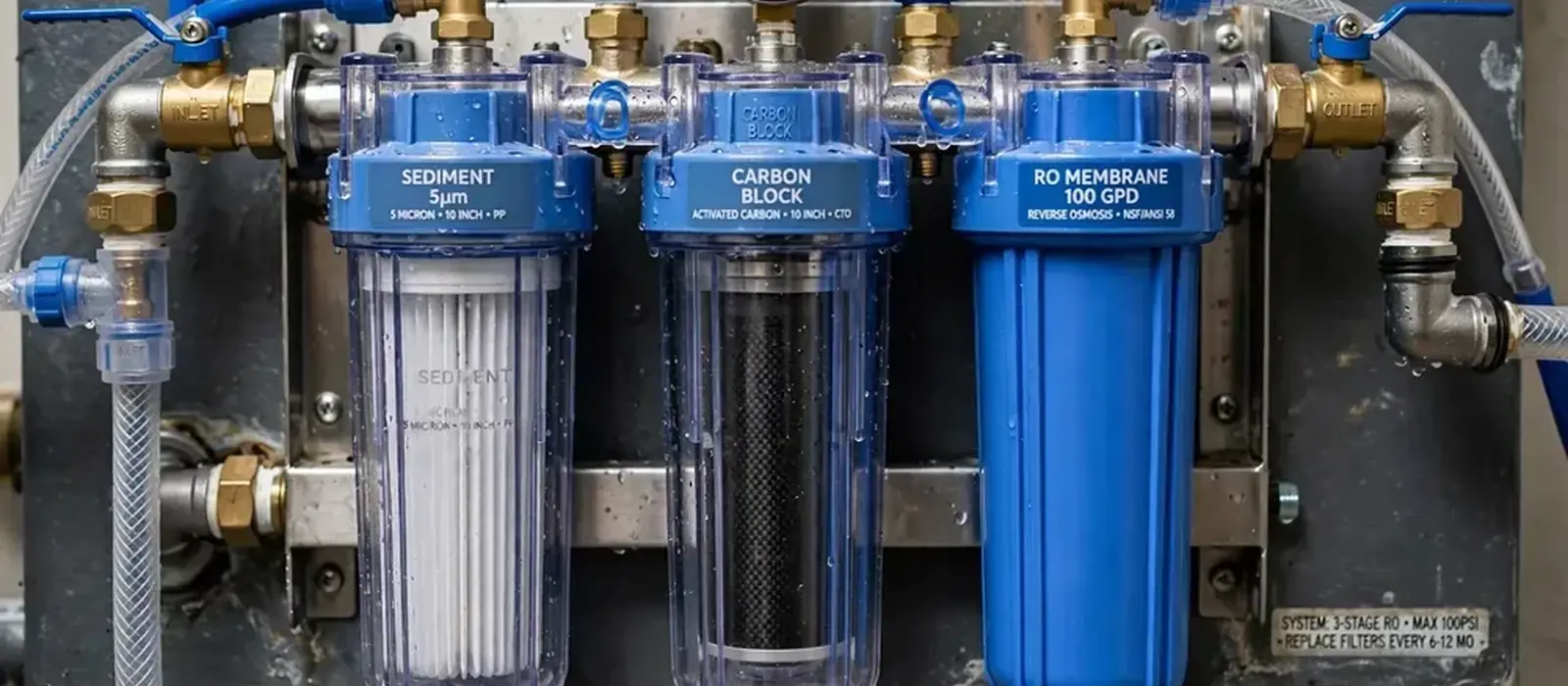
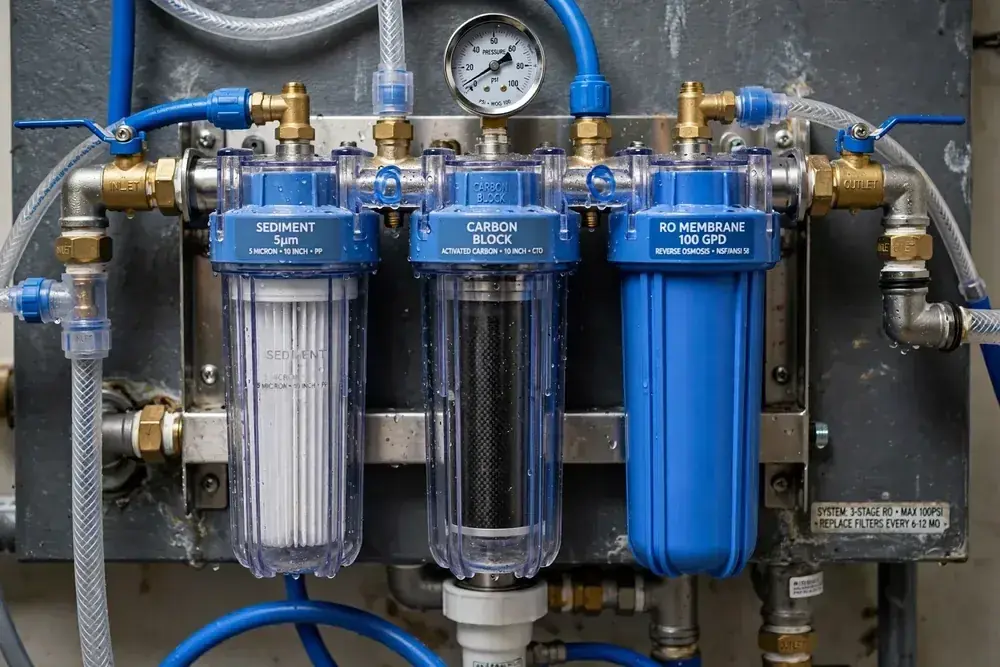
A system is usually a sequence of these.
| Stage | Removes or reduces | Does not do |
|---|---|---|
| Sediment filter | Sand, silt, rust particles | Dissolved minerals or chemicals |
| Carbon filter | Chlorine taste and odor, some organics | Hardness |
| Reverse osmosis | Many dissolved solids | Produces waste water, treats one tap |
| Water softener | Hardness minerals | Does not filter contaminants |
What the city report says
The City of Fountain Valley's 2026 water quality report, covering 2025 data, lists average hardness of 217 milligrams per liter, or 13 grains per gallon, with a range of 10 to 15. The report also states that the city supplied groundwater only in 2025.
Hardness is a mineral issue, and carbon or sediment filters do not remove it. If scale is your concern, you need a softener or a conditioner. If taste is your concern, carbon helps. Read the full report on the city's website before choosing.
Source type: City of Fountain Valley 2026 Water Quality Report
Whole-house or point-of-use
A whole-house system treats all water as it enters. It protects fixtures and appliances, but it needs space, a bypass and professional plumbing. A point-of-use system, such as an under-sink reverse osmosis unit, treats one tap, usually for drinking.
Many homes use both. A sediment and carbon filter at the main plus an under-sink unit at the kitchen is a common pattern.
Planning an install
Test the water
Use the city report, a hardness test kit and, if needed, a lab test.
Choose stages
Pick stages that match your goals, and avoid paying for unneeded treatment.
Find the location
A whole-house unit needs space near the main with a drain and power if required.
Install with bypass valves
Valves let you service the unit without shutting off the house water.
Be cautious with claims
Marketing for filters often implies broad health benefits. Look for third-party certification for the specific contaminant you care about. If a safety question is involved, ask your water provider or a lab.
Maintenance matters
Filters clog, carbon saturates and softener resin ages. Replace cartridges on schedule, or flow and quality drop. Keep a log of install dates and change dates.
A neglected filter can become a source of bacterial growth. If a filter has sat unused, flush it as the manufacturer directs before drinking from it.
Choosing between cartridge and tank systems
Cartridge filters are compact housings that hold a replaceable filter. They are simple and inexpensive, and they suit sediment and carbon stages. Tank systems hold media such as carbon or resin in a large vessel. They handle higher flow and last longer between changes, but they take more room.
Match the system to your flow. A whole-house setup that is too small drops pressure, and one that is too large wastes money. A plumber can size it from the number of fixtures and the pipe diameter.
Drinking water versus fixture protection
Two goals often get mixed. If you want better drinking water, treat the kitchen tap with carbon or reverse osmosis. If you want to protect fixtures and appliances from scale, treat the whole house with a softener or conditioner. They are separate problems with separate tools.
Most households do well with one of each. A small kitchen unit handles taste, and a whole-house unit handles hardness. Skipping the second stage means scale keeps building in the water heater.
Questions to ask a seller
Ask what the system removes and what third-party certification supports the claim. Ask what upkeep it needs, what each filter costs and how often you replace it. Ask where the waste water goes and whether the drain connection is allowed in your area.
A seller who cannot answer those questions plainly is not worth hiring. Avoid anyone who promises to fix every water problem with one product.
Standards to look for on a filter
Look for third-party certification to NSF/ANSI standards for the contaminant you care about, such as NSF/ANSI 42 for taste and odor and NSF/ANSI 53 for health-related contaminants. Plumbing connections follow the California Plumbing Code, based on the Uniform Plumbing Code (UPC).
Getting help from a plumber
The plumbing side of a system, including shutoffs, bypass and drain, is where mistakes cost money. Our water softener and filtration page describes how we plan an install, and the plumbing installation page covers fixtures and valves.
We serve Fountain Valley and the neighboring city of Santa Ana, where the city reports average groundwater hardness of about 14 grains per gallon. The service areas page explains how coverage works.
Questions Fountain Valley Homeowners Ask
No. Carbon filters address taste and odor. Hardness needs a softener or conditioner.
Only if you want to reduce dissolved solids at a drinking tap. Many homes do fine without.
The city's 2026 report lists an average of 13 grains per gallon.
Simple under-sink units are doable. Whole-house systems usually need a plumber.
Follow the manufacturer's schedule, often every few months to a year depending on the stage.